Volatility Dynamics Explored in Free-to-Paid Slot Game Transitions Focusing on Bonuses and Jackpot Mechanisms
Nils Keller · Aug 14, 2026
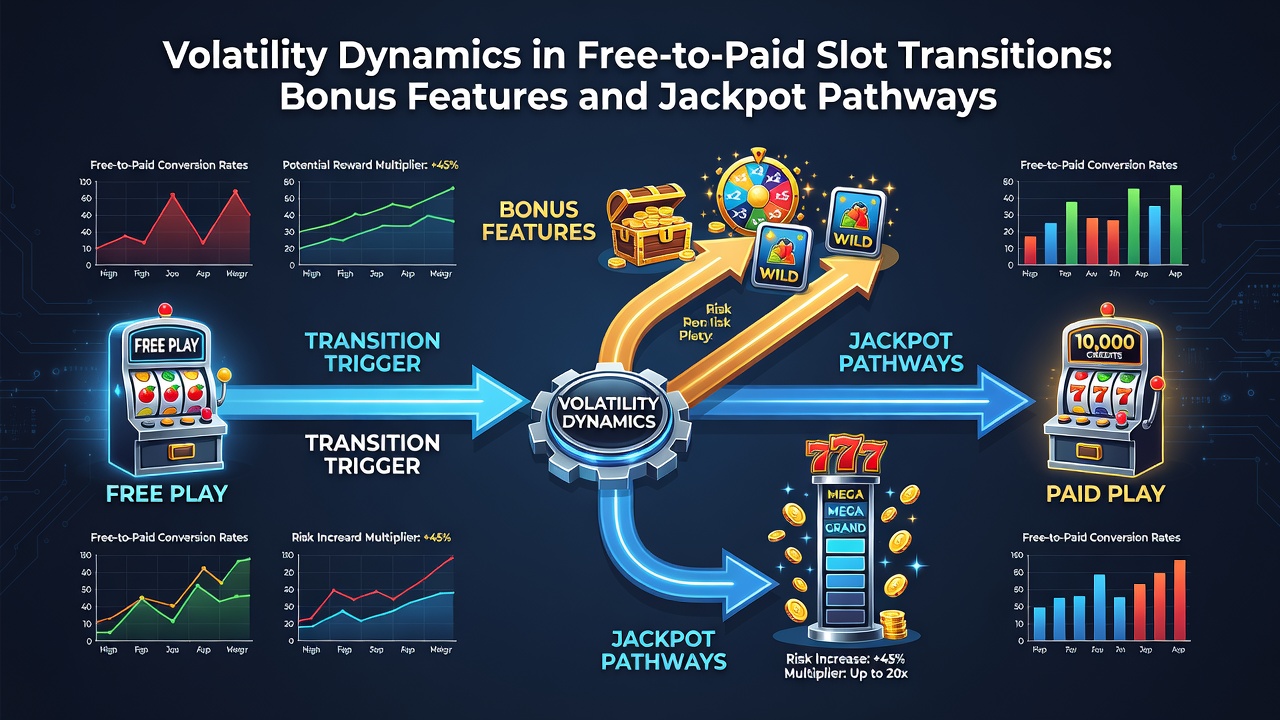
Volatility Dynamics Explored in Free-to-Paid Slot Game Transitions Focusing on Bonuses and Jackpot Mechanisms
Volatility in slot games measures the balance between payout frequency and size, and this factor shifts noticeably when players move from free demo versions to real-money sessions where bonus features and jackpot routes introduce additional layers of risk and reward according to industry analyses. Researchers have documented how demo modes often present smoothed volatility experiences that mask the sharper swings encountered once real stakes enter the equation, while bonus rounds serve as key modifiers that can either dampen or amplify those swings depending on their design parameters.
Core Concepts of Slot Volatility
Slot volatility operates on a spectrum where low-volatility titles deliver frequent smaller returns and high-volatility options produce infrequent larger payouts, and data from gaming mathematics studies confirm that these patterns remain consistent across both free and paid environments even though player perception changes during the transition. Game providers calibrate return-to-player percentages and hit rates to maintain mathematical integrity, yet the psychological impact intensifies once monetary value attaches to each spin because bonus features then carry real financial consequences rather than simulated ones.
Transitions from Free Play to Real Stakes
Players who begin in free-to-play modes encounter identical random number generator outcomes as those in paid versions, but the absence of financial risk during demos creates a compressed sense of volatility that expands dramatically upon the shift to real-money play where jackpot pathways become tangible objectives. Studies on player behavior indicate that individuals often underestimate variance after extended demo sessions, leading to adjusted bankroll strategies once actual deposits activate the same underlying mechanics. This adjustment period typically spans several sessions as users recalibrate expectations around bonus trigger frequencies and the distribution of jackpot contributions.
Bonus Features as Volatility Modifiers
Bonus features function as volatility regulators because they concentrate larger payout potential into discrete rounds that occur at irregular intervals, and mathematical models show these elements can elevate overall game volatility by 20 to 40 percent depending on their frequency and multiplier structures. Free spins, pick-and-click rounds, and expanding wild mechanics alter the payout distribution curve, which means players experience clustered wins separated by longer dry spells once real stakes apply. Observers note that certain bonus designs incorporate progressive elements that further stretch volatility ranges, creating pathways where a single bonus sequence can connect directly to jackpot territory.

Take one analysis released in August 2026 by gaming research institutions that examined thousands of slot sessions across multiple jurisdictions, and the findings revealed bonus features account for approximately 35 percent of total return variance in high-volatility titles during the first 500 spins after a player transitions to paid mode. Those who've tracked these metrics across different platforms observe that the same bonus structure produces measurably different perceived volatility when real currency replaces demo credits because loss aversion amplifies the impact of non-triggering spins.
Jackpot Pathways and Their Influence
Jackpot pathways introduce additional volatility dimensions through progressive accumulation and tiered prize structures, and data compiled by regulatory bodies such as the Nevada Gaming Control Board demonstrate that these systems increase the tail-end risk profile of slot games by extending the upper payout range while maintaining the same base hit frequency. Players navigating from free to paid versions encounter these pathways as extended bonus chains that require specific symbol combinations or accumulated values to activate, which mathematically widens the gap between expected and realized outcomes. Industry reports further indicate that jackpot contribution percentages, typically ranging from 1 to 3 percent of each bet, directly scale volatility upward without altering the core reel mathematics.
Observed Patterns in Player Data
Longitudinal tracking of session data shows that volatility perception stabilizes after roughly 1,000 paid spins, at which point users develop more accurate assessments of bonus feature reliability and jackpot accessibility compared to their initial free-to-paid transition period. Academic research published through university gaming studies programs has quantified how players who engage with multiple demo sessions beforehand exhibit faster adaptation rates once real money activates the same volatility profile. These patterns hold across various game themes and providers because the underlying random number generation remains constant regardless of play mode.
Conclusion
Volatility dynamics during free-to-paid slot transitions hinge on the interaction between unchanged mathematical structures and the introduction of real financial stakes, with bonus features and jackpot pathways serving as primary amplifiers of variance according to available data. Players and analysts alike benefit from recognizing that demo experiences provide accurate outcome distributions yet fail to replicate the adjusted risk assessment that occurs once monetary value attaches. Continued examination of these transitions through regulatory and academic channels supplies clearer benchmarks for understanding how volatility manifests across different play contexts.